
Research note
Incoin Pay: An Evidence-Based Look at a UPI-Based “Crypto” Platform
On this page
- 1. Not available on the Google Play Store
- 2. Deposits and withdrawals through UPI apps
- 3. No blockchain verification (TXIDs)
- 4. A proprietary token with no market presence
- 5. Fixed returns of around 3–3.5%
- 6. Referral-driven rewards
- 7. Publicly reported user issues
- 8. Targeting students and first-time users
- Conclusion
- A note for students
Disclaimer: This note is written solely for educational and awareness purposes. It is not financial or legal advice and does not allege criminal intent. The analysis is based on publicly observable app behaviour at the time of writing, user-reported issues and standard crypto architecture principles.
With growing interest in cryptocurrency among students and young professionals in India, several apps claim to offer crypto mining, passive income or investment returns. One of them is Incoin Pay.
This note evaluates whether the platform aligns with how legitimate crypto systems work, or shows high-risk characteristics.
1. Not available on the Google Play Store
Observation: Incoin Pay is not listed on the Google Play Store and is distributed only through APK files and referral links.
Why it matters: Financial and crypto apps on the Play Store must comply with policies on misleading financial claims, guaranteed returns and user fund protection. Avoiding official app stores removes those safeguards and significantly increases user risk.
2. Deposits and withdrawals through UPI apps
Observation: The app shows tutorials instructing users to link UPI apps such as PhonePe, Freecharge and MobiKwik for deposits and withdrawals.
Technical reality:
- UPI is a bank payment system run by NPCI, not a blockchain protocol.
- Crypto wallets do not move funds over UPI.
- Apps that connect to UPI need NPCI approval and a partner bank.
Key distinction:
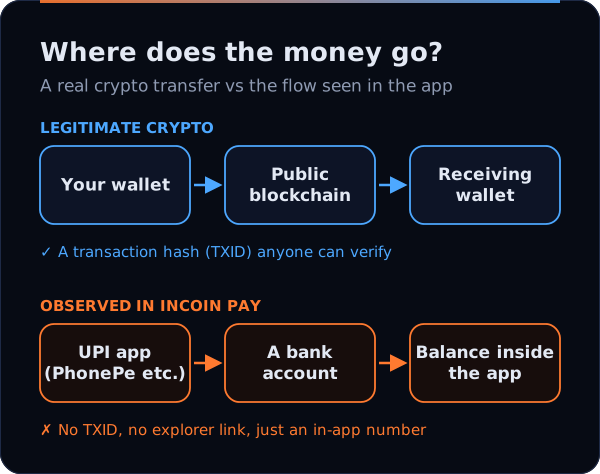
This indicates direct rupee transfers into a bank account, not blockchain transactions.
3. No blockchain verification (TXIDs)
Observation: Users are not given transaction hashes (TXIDs), blockchain explorer links (such as Etherscan or Tronscan) or any proof of on-chain custody.
Why it matters: Genuine crypto transactions are public, verifiable and independently auditable. Without a TXID, a user cannot confirm their funds ever reached a blockchain.
4. A proprietary token with no market presence
Observation: The platform claims to use its own token. I found:
- No listing on CoinMarketCap or CoinGecko
- No availability on centralised or decentralised exchanges
- No publicly disclosed smart contract address
- The token is usable only inside the app
A token without external liquidity has no independent market value.
5. Fixed returns of around 3–3.5%
Observation: The platform displays predictable, fixed returns, often around 3–3.5%.
Financial reality: Crypto markets are volatile, and legitimate platforms do not guarantee returns. Fixed returns without regulatory approval are a common red flag. In India, offering guaranteed investment returns without the relevant regulatory authorisation is legally restricted.
6. Referral-driven rewards
Observation: Earnings increase significantly through referrals, team-based rewards and downline commissions.
This creates dependence on a continuous flow of new users rather than on any value being generated, a pattern frequently seen in high-risk schemes.
7. Publicly reported user issues
Across online discussions and feedback forums, users have repeatedly reported:
- Withdrawal requests staying pending for long periods
- Account restrictions after attempting a withdrawal
- Balances visible in the app but not withdrawable
- “System maintenance” or “network upgrade” responses during withdrawal attempts
- Difficulty reaching effective customer support after depositing
Individual experiences vary, but the repetition of these issues is notable and warrants caution.
8. Targeting students and first-time users
Observation: Marketing and peer-to-peer promotion appear focused on students, small initial deposits, “easy income” messaging and social referrals. These groups are more vulnerable to financial misinformation, which makes transparency especially important.
Conclusion
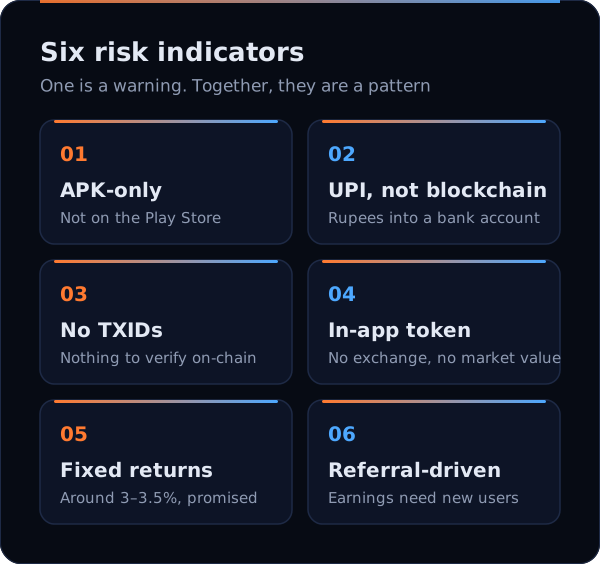
Based on observable technical behaviour, user-reported issues and comparison with standard crypto architecture, Incoin Pay does not align with how legitimate crypto platforms operate.
Key risk indicators:
A note for students
Before trusting any app like this, pause and verify. Platforms not recognised or regulated by authorities such as the RBI or SEBI carry significant risk, and missing basics like a registered office address or clear company details make independent verification hard. A few minutes of checking can save you real financial and emotional stress.