
Research note
Designing a Safer Railway Handover System
On this page
- 1. The concept
- 2. Why isn’t this simply another cloak room?
- 3. I started asking: “What could go wrong?”
- 4. The biggest lesson: security must override convenience
- 5. The QR code is not the security system
- 6. The security problem became cyber-physical
- 7. Then came the hardest question
- 8. From “smart locker” to “monitored containment module”
- 9. What about explosives?
- 10. Protective engineering already exists in India
- 11. Protective storage isn’t just a thick metal box
- 12. Threat modelling: organised crime and terrorism
- 13. People remain part of the security architecture
- 14. The architecture I arrived at
- 15. The prototype must be safe
- 16. What a real deployment would require
- 17. What success should mean
- 18. The bigger idea
- Conclusion
What started as a simple railway handover idea became a study in security, cyber-physical systems, human factors, emergency response and infrastructure safety.
Imagine a passenger at a railway station who needs to send a permitted item to another passenger. Today, the sender generally has to wait for the receiver, find them physically, or use some other informal arrangement.
My proposed Railway Handover Service explores a different model:
Person A deposits a permitted item → railway staff verifies and stores it → Person B later collects it through a controlled verification process.
At first, this sounds like a locker system. But during my research I realised something important:
The difficult problem isn’t storing the package. The difficult problem is safely transferring custody from one person to another inside a safety-critical public infrastructure environment.
That changed the entire direction of the project.
1. The concept
The initial concept was a staff-assisted, QR-based railway handover service. A sender approaches an authorised railway handover counter and submits a permitted item. The process would be approximately:
Sender → Verification → Payment → Locker Assignment → Storage → Receiver Notification → Receiver Verification → Staff Retrieval → Handover → Transaction Closure
The QR code identifies the transaction and helps staff retrieve the correct record. Importantly, my design does not treat the QR as a direct electronic key to the locker. The physical package remains under staff-controlled custody.
2. Why isn’t this simply another cloak room?
Indian Railways already has cloak-room and locker facilities at authorised stations, so claiming my innovation is simply “a digital railway locker” would be weak. The difference is the person-to-person handover workflow.
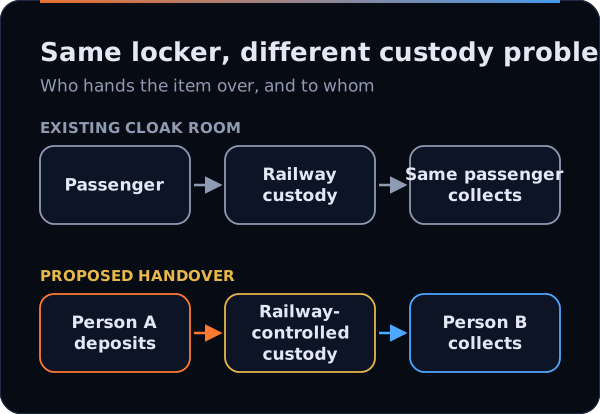
That creates a new chain-of-custody problem, and once I recognised that, the security research became much deeper.
3. I started asking: “What could go wrong?”
Instead of designing only for the happy path, I created a 100-scenario worst-case risk analysis. The scenarios covered:
- Misuse: dangerous or prohibited items, deliberate criminal use, suspicious packages, unauthorised representatives
- Custody failures: wrong-person collection, package substitution, locker assignment errors, valuable-item disputes, unclaimed packages, lost phones
- Insider risk: staff theft, staff/customer collusion, maintenance-access abuse, master-key compromise, social engineering
- Digital attacks: QR replay and tampering, fake QR codes, payment manipulation, compromised administrator accounts, ransomware, database breaches, audit-log tampering, phishing, API authorisation failures, DDoS, supply-chain compromise
- Physical hazards: forced locker access, fire, flooding, leaking packages, passenger injury
- Operations: internet and power failures, CCTV failure, crowd surges, evacuation, station lockdown, emergency overrides, staff fatigue
- People and policy: accessibility and language problems, legal and policy gaps
The analysis identified 100 distinct failure scenarios, but it is a concept-level risk assessment, not legal advice, security certification or operating authorisation.
4. The biggest lesson: security must override convenience
One principle emerged repeatedly:
When security conditions deteriorate, convenience stops.
- A passenger’s train leaving in two minutes cannot justify bypassing verification.
- An internet outage cannot automatically mean staff manually release packages.
- Someone claiming to be a senior official cannot automatically authorise package access.
- A suspicious package means normal handover operations stop in the affected area.
The system therefore needs controlled operational states:
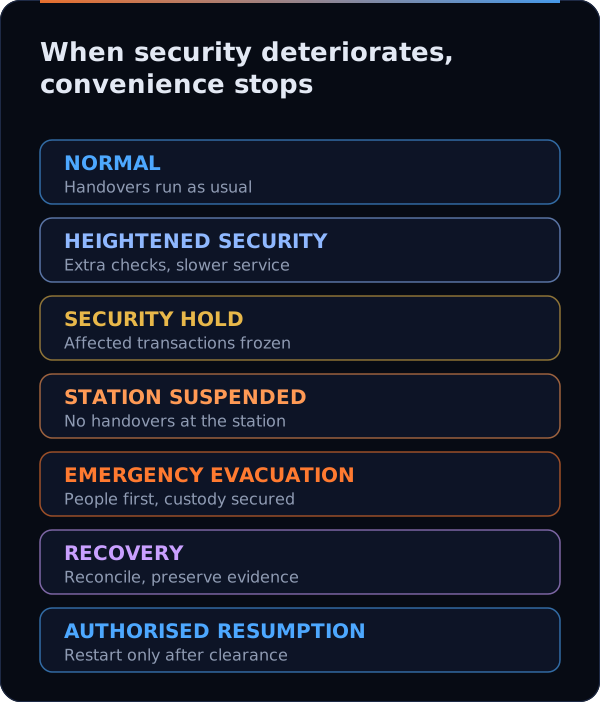
These states must remain connected to the railway’s authorised command structure rather than creating a parallel security organisation.
5. The QR code is not the security system
One of the most important architectural decisions was separating digital authorisation from physical access. A QR code should identify a transaction. It should not independently decide “this person has a QR, therefore give them the package.”
My architecture uses:
QR/token + transaction state + staff verification + secondary verification where required + physical evidence
The system records the handover ID, package description, package evidence or photo where permitted, sender and receiver information, staff identity, locker or counter, timestamps, notification status, collection attempts, the final handover and any exceptional events. This makes every transaction reconstructable if something goes wrong.
6. The security problem became cyber-physical
The system isn’t purely digital, and it isn’t purely physical. A cyber compromise could affect a physical transaction:
Phishing → Stolen Credentials → Privileged Access → Transaction Manipulation → Incorrect Authorisation → Physical Package Release
So controls need to exist at multiple levels: unique staff accounts, MFA, role-based access control, least privilege, server-side authorisation, protected audit logs, privileged-action monitoring, secure transaction states, network protection, backups, incident response and controlled physical access.
7. Then came the hardest question
What happens if something dangerous gets into storage?
No declaration system is perfect. No staff inspection is perfect. No screening technology detects every possible threat. The system cannot be designed around the assumption that a dangerous item will never enter the locker.
Instead, I researched a second defensive layer: continuous storage monitoring.
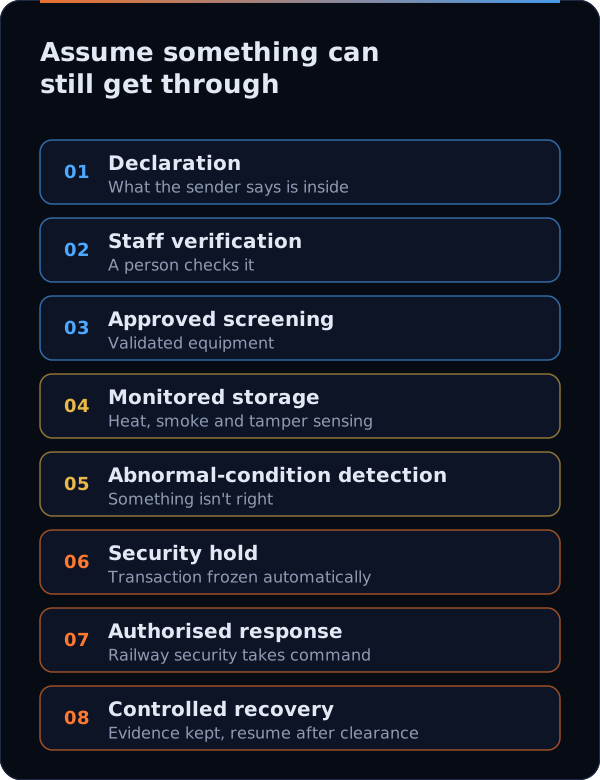
The purpose isn’t to replace screening. It is to address the residual risk after screening.
8. From “smart locker” to “monitored containment module”
Instead of a smart locker, I started thinking of a monitored, engineered storage module with four conceptual layers:
- Physical: controlled individual compartments, tamper monitoring, controlled staff access, CCTV and security integration
- Monitoring: environmental, thermal and smoke/particulate sensing, door and tamper monitoring, other professionally validated sensors where appropriate
- Digital: transaction identity, QR/token lifecycle, secure state management, protected audit records
- Response: automatic security hold, alerting, affected-area identification, evidence preservation, escalation to railway emergency and security teams
The system should detect, alert, hold, isolate and escalate, rather than attempt to make autonomous emergency decisions.
9. What about explosives?
I considered the possibility of concealed explosive material, but deliberately set an important boundary:
I cannot claim that a locker can automatically identify explosives or guarantee containment of an explosive event without specialist engineering, validated detection technology and controlled certification testing.
The correct research position is consequence reduction, not a “bomb-proof locker”. Detect early. Do not expose staff. Hold the transaction. Protect people. Alert the authorised response chain. Preserve evidence. Resume only after clearance.
10. Protective engineering already exists in India
India already has significant expertise in blast-resistant structural engineering. CSIR–Structural Engineering Research Centre has worked on blast-resistant explosive-storage structures and specialised protective engineering. So this project doesn’t need to pretend to invent that from scratch. The more interesting research question is:
Can established protective-engineering principles be integrated with railway package custody, digital verification, continuous monitoring and emergency response?
11. Protective storage isn’t just a thick metal box
Protective storage cannot be reduced to “use thicker steel”. A real deployment would need qualified specialists to evaluate the complete system: structural response, fire effects, energy absorption, fragment protection, mounting and surrounding structure, access control, sensor reliability, emergency access, maintenance, failure modes, site-specific conditions, applicable standards and controlled acceptance testing.
My proposed module is a research architecture, not a certified containment product.
12. Threat modelling: organised crime and terrorism
I also performed a separate assessment covering organised criminal use, coordinated theft and distraction, insider/external collusion, staff impersonation, fake handover counters, fake QR codes and signage, bomb threats, coordinated station attacks, riots and stampedes, cyber-physical attacks, compromised accounts, fake transactions, locker-resource exhaustion, evidence tampering and fake authority requests.
The conclusion wasn’t “my system can stop terrorism”. That would be an irresponsible claim. The correct conclusion is:
The service must operate inside the existing railway security and emergency framework, contributing controlled custody, transaction traceability and evidence while authorised security agencies retain security command.
13. People remain part of the security architecture
A tired employee can make a mistake. A criminal can apply social pressure. A crowd can create confusion. An emergency can change everything.
So the design also covers staff training, shift design, checklists, mandatory evidence capture, unique credentials, independent review, escalation authority, emergency drills, safe refusal procedures, supervision and least-privilege access.
One of the most dangerous assumptions in security engineering is “the system will prevent the human from making a mistake.” A better principle:
Design the system so one human mistake does not automatically become a catastrophic failure.
14. The architecture I arrived at
A nine-layer custody architecture:
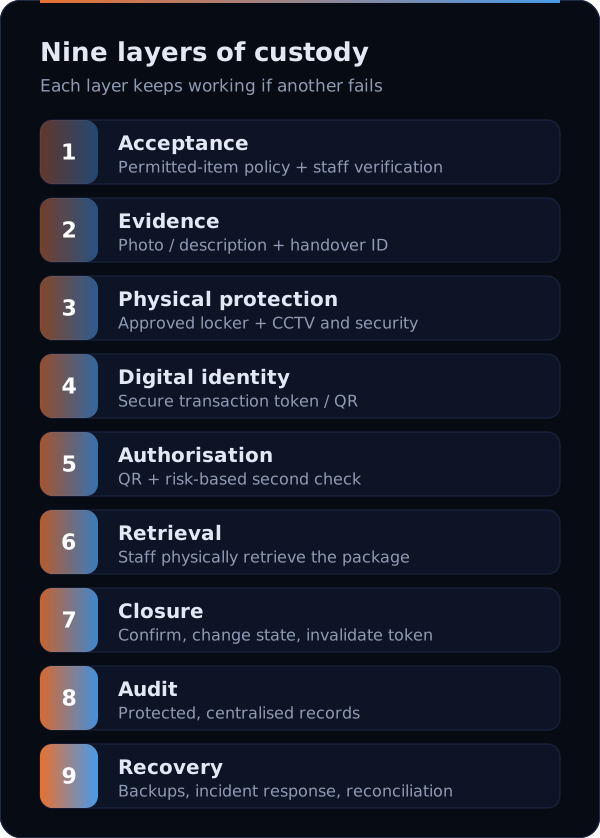
Each transaction follows a controlled state machine:
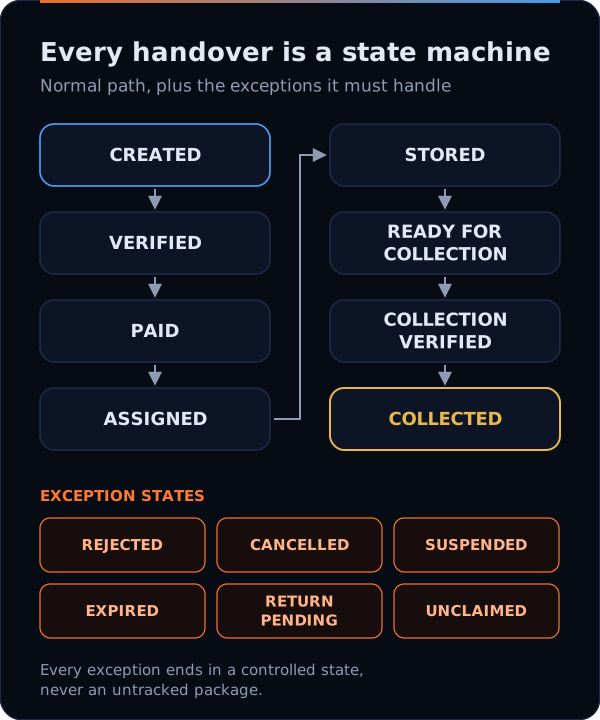
15. The prototype must be safe
A student prototype should never use explosives, suspected explosives or hazardous materials. A safe prototype can demonstrate a model locker, dummy packages, simulated sensors and alarm signals, a simulated security hold, the QR transaction system, CCTV event simulation, emergency notifications, audit logging, internet and power failure scenarios and cyber incident simulations.
A real-world system would require professionally engineered protective infrastructure, validated detection systems, railway approvals and controlled testing.
16. What a real deployment would require
At least five gates:
- Legal & policy approval: accepted items, liability, tariffs, privacy, unclaimed property, operating authority
- Railway safety & security approval: station layout, passenger movement, emergency procedures, RPF/GRP/security integration, physical access
- Cybersecurity assessment: architecture review, penetration testing, access-control review, logging, backup and recovery validation
- Controlled operational pilot: a limited number of stations and controlled volumes
- Independent post-pilot review: incidents, near misses, custody failures, complaints, availability and SOP compliance, before considering scale
17. What success should mean
Not “how many packages can it store?” but:
- Wrong-person release rate
- Custody reconciliation failures
- Dangerous-item incidents
- Suspicious-event response time
- QR replay attempts
- Payment exceptions
- Unclaimed packages
- Complaints per 1,000 transactions
- System availability and recovery time
- Staff SOP compliance
- Security-hold events
The objective is not maximum convenience. It is safe, traceable and accountable handover.
18. The bigger idea
The project began with a simple question: can one passenger leave an item at a railway station for another passenger to collect later?
It became a bigger one: can I create a railway-authorised, staff-assisted digital chain-of-custody system that remains safe under operational, physical, cyber, human and emergency failure conditions?
The most important conclusion: a railway handover service should not be designed as a locker. It should be designed as a controlled custody system. The locker is only one component. The real system is:
People + Policy + Physical Security + Digital Identity + Monitoring + Evidence + Cybersecurity + Emergency Response + Recovery
Conclusion
The Railway Handover Service is a research and concept proposal. It is not an approved railway product and not a certified protective-storage system. It could be explored further through controlled prototyping, formal risk assessment and collaboration with railway, security, cybersecurity, structural-engineering and emergency-response specialists.
The lesson applies far beyond railway stations:
Security isn’t one feature. It is a system of layers designed to keep working when individual layers fail.
And for critical public infrastructure: when security conditions deteriorate, convenience stops.
Research basis
This note is based on my Railway Handover Service concept presentation, a 100-scenario worst-case risk analysis, a terrorism/organised-crime and station-security threat model, and blast-resistant storage research. The research is defensive and concept-level. It does not claim engineering certification, explosive-containment certification, railway authorisation or operational approval.